
Owner guides — / 01
The stain below the bathroom is almost never the roof
Five things cause a brown patch on a ceiling under a bathroom. They are not equally expensive, and telling them apart takes about a day of doing nothing.
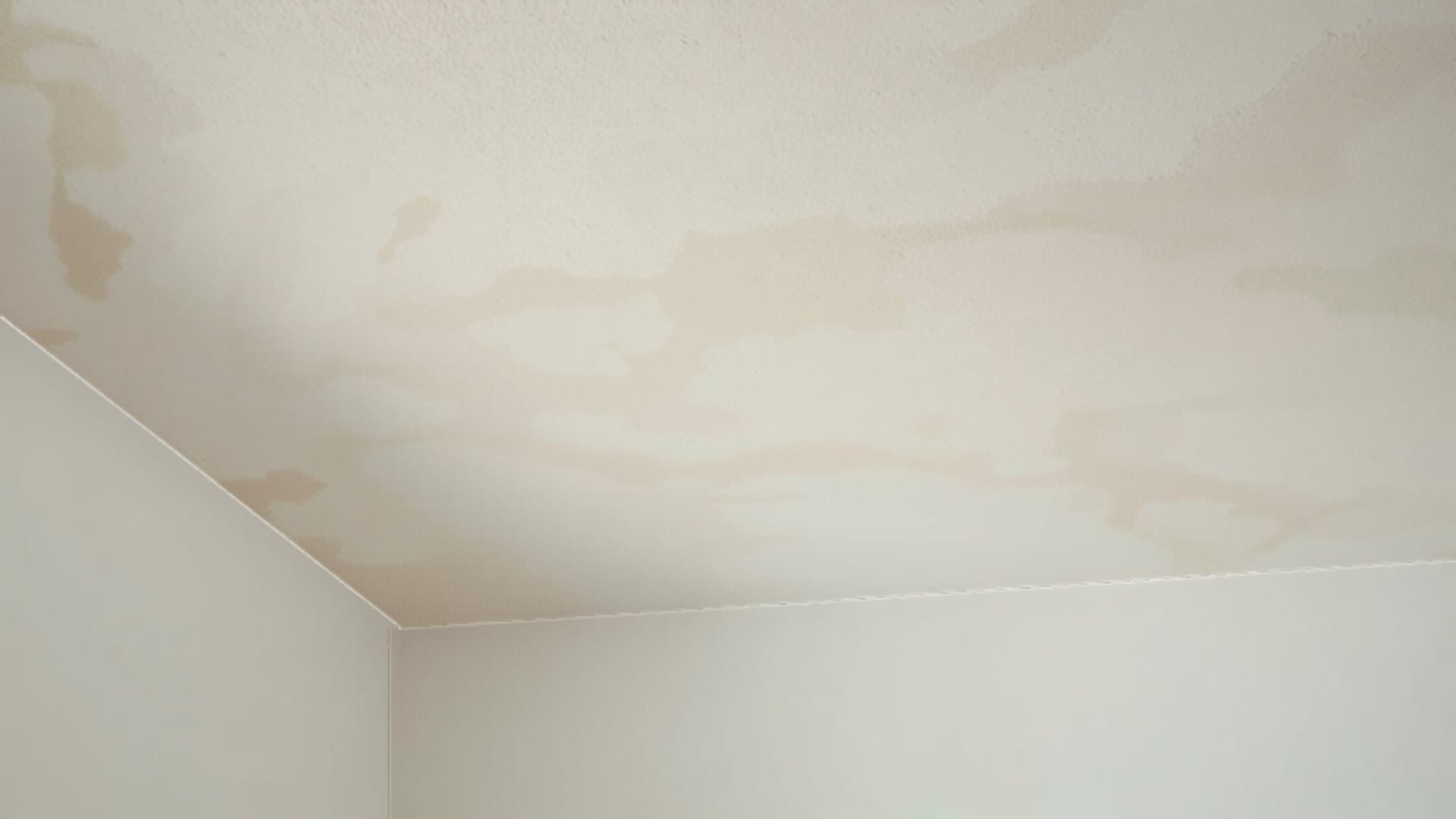
Someone sends you a photograph. A brown-edged patch on a ceiling, in a room directly below a bathroom. The first question every owner asks is whether the roof is leaking.
In Bahrain it usually isn't. Bahrain records around 70 mm of rain in an average year, and almost all of it falls between November and April. A stain that appears in midsummer, or one that keeps growing through the summer, has nothing to do with weather. It has to do with the bathroom above it.
What the stain is actually telling you
A stain is not the leak. It is the far end of the leak — the point where water that has been travelling through a slab or a screed for days or weeks finally reaches a surface it can discolour. By the time it shows, the water has already been there a while.
That is why the location of the stain is a poor guide to the location of the fault, and why opening the ceiling at the stain is often the wrong first move. What is diagnostic is timing: when the stain grows, and what has to happen first.
The five candidates, and how each behaves
A pressurised supply pipe
Cold or hot feed to the basin, shower or cistern. The only one that leaks continuously, because the pipe is under pressure whether anyone is in the room or not.
A waste or drain pipe
These carry water only while a fixture is running, so the stain darkens after use and dries back between times.
Failed waterproofing under the floor
The most common cause and the most often misdiagnosed. Water gets past tile grout or a perished silicone joint, soaks into the screed, and travels sideways until it finds a way down. People chase this one as a plumbing fault for months.
The air-conditioning condensate line
The Bahrain wildcard, and the reason this diagnosis differs here. A split unit pulls litres of water out of the air every summer day, and that water leaves through a small drain line running through the same ceiling void as the plumbing. Dust and biological growth block those lines, and the pan overflows.
The roof, or the roof tank
Only if the room is on the top floor — and only after the four above have been excluded, not before.
Do this first
The test that costs nothing
It narrows five causes to two, and you do not need anyone in the building to run it.
- 01Take a pencil. Draw a line around the edge of the stain and write today's date on the ceiling beside it. A photograph alone is not enough — you cannot judge a few millimetres from two pictures taken at different distances.
- 02Do not use the bathroom for 24 hours. Not the basin, not the shower, not the WC.
- 03Look again. If the stain has grown past your line with nobody using the room, it is a pressurised supply pipe — and it is running right now.
- 04If it has not grown, use one fixture at a time on separate days. Whichever one moves the line is where to look first.
- 05If nothing moves the line and the weather is hot, turn your attention to the AC drain. If that same unit is also failing to cool the room, that has its own diagnosis.
What it costs to wait
Water in a screed does not dry out. It migrates, and it takes whatever is dissolved in it along. The sequence is predictable: staining, then blown plaster, then paint lifting over a widening area, then — in a coastal, salt-laden environment — corrosion beginning on the reinforcement inside the slab. What that looks like from the outside is a separate guide.
The gap between resealing a shower joint and re-waterproofing a wet area is large. The gap between re-waterproofing a wet area and repairing a slab is much larger.
What a proper diagnosis looks like
A competent visit isolates before it opens anything: fixtures tested one at a time, a moisture meter used to map how far the damp has actually spread rather than where it is visible, the AC drain checked before the plumbing is blamed, and then the smallest possible opening made at the point the evidence indicates — not at the stain. Anyone who arrives and immediately breaks out tiles has skipped the diagnosis.
The repair is then whichever of the five it turned out to be, and you will know why.
Send us the photograph before you send anyone a hammer.
Al Wajaha Projects has looked after buildings in Bahrain since 1987. Send a picture of the ceiling and roughly where the bathroom sits above it, and we will tell you which of the five it most likely is.